Landing Page vs Homepage Conversion: Which One Drives More Leads?

Landing Page vs Homepage Conversion: Which One Drives More Leads?

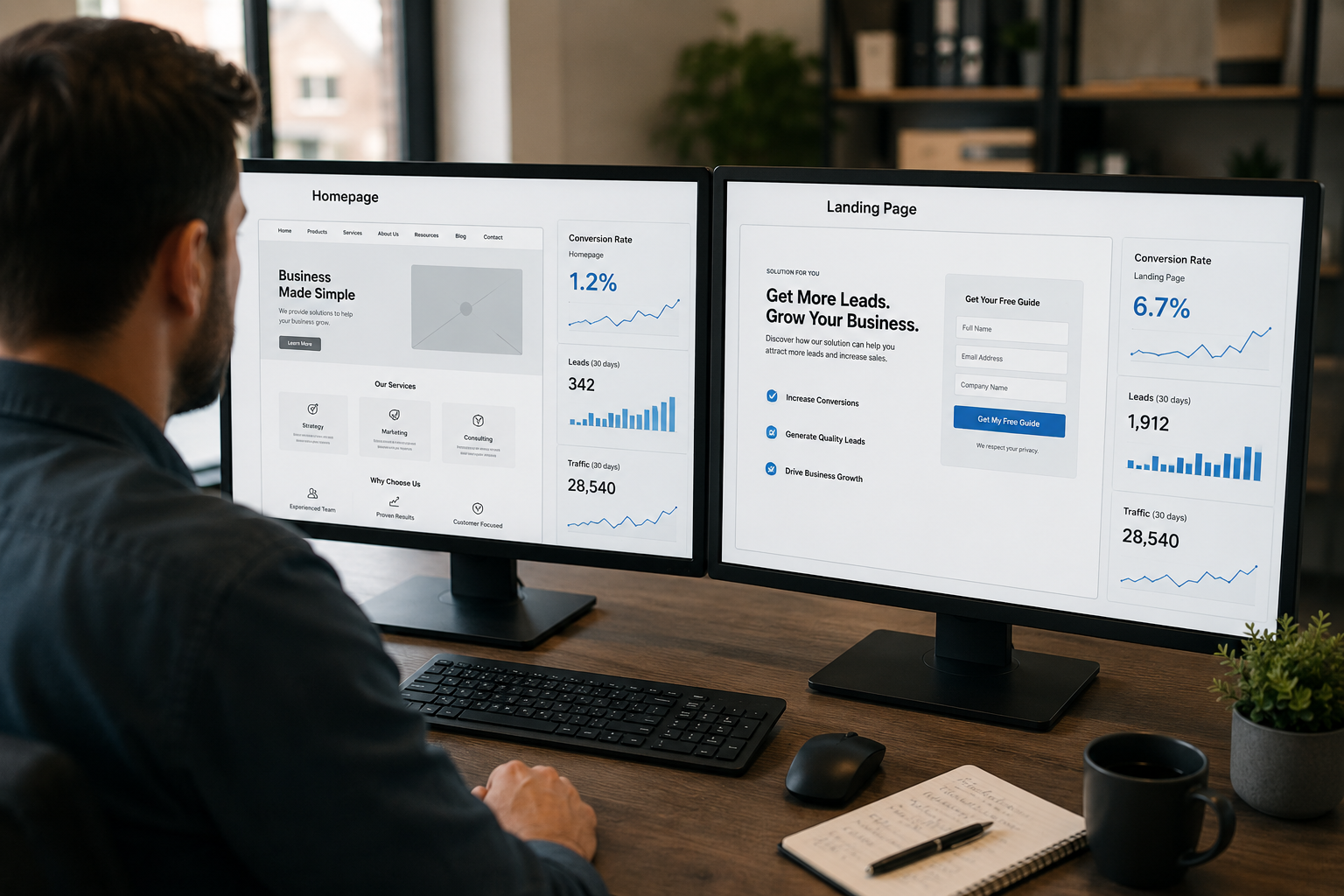
When comparing landing page vs homepage conversion, you’re really asking how focused your website experience should be when someone is ready to take action. Both pages matter, but they are built for different jobs.

Your homepage is often the front door of your website. It introduces your business, explains what you do, points visitors toward key services, and helps people understand your brand. A landing page is more focused. It is usually created for one campaign, one audience, one service, or one offer.

For small businesses trying to generate leads online, that difference can have a major impact. A homepage can build trust and guide visitors, but a landing page often converts better when traffic comes from ads, emails, social media campaigns, or specific service searches.

The stronger strategy is knowing when to use each one.

What Is the Difference Between a Homepage and a Landing Page?

A homepage gives visitors a broad overview of your business. It usually includes navigation, multiple service links, company information, calls to action, testimonials, location details, and paths to several different parts of the website.

That makes sense because homepage visitors often arrive with different levels of intent. Some are researching. Some are comparing companies. Some are returning customers looking for contact information. Others are trying to figure out whether your business offers what they need.

A landing page is narrower by design. It is built around one clear goal, such as booking a consultation, requesting a quote, downloading a guide, signing up for a service, or calling the business. The content, layout, headline, form, and call to action all support that one conversion goal.

Google defines a landing page as the webpage people reach after clicking an ad, and its advertising guidance emphasizes that landing page experience is influenced by relevance, usefulness, and ease of navigation (Google Ads Help, Google Ads Help).

Landing Page vs Homepage Conversion: Which Usually Performs Better?

In most campaign situations, landing page vs homepage conversion comes down to focus. A landing page often drives more leads because it removes distractions and keeps the visitor moving toward one action.

Imagine a local business running Google Ads for “emergency plumbing repair.” If someone clicks that ad and lands on the homepage, they may see links for plumbing, HVAC, financing, company history, blog posts, careers, and general contact information. Some of that content may be useful, but it also creates more opportunities to drift away from the original goal.

If that same visitor lands on a dedicated emergency plumbing page with a clear headline, urgent service details, trust signals, service area information, and a prominent call button, the path is much cleaner.

That is why dedicated landing pages are so valuable for paid ads and targeted campaigns. Unbounce’s landing page benchmark report, based on tens of millions of conversions, shows that landing page conversion performance varies widely by industry, which is another reminder that page design, audience intent, and offer quality all matter (Unbounce).

A homepage can still convert well, especially for branded searches and returning visitors. But when the traffic source has a specific intent, a focused landing page usually gives that visitor a better path to action.

Why Homepages Still Matter for Lead Generation

It would be a mistake to treat the homepage as less important. For many small businesses, the homepage is one of the most visited pages on the website. It is also where many people go after seeing a social media post, reading a review, hearing about the business from a friend, or searching the company name directly.

A strong homepage helps visitors understand the business quickly. It should communicate who you serve, what problems you solve, why customers trust you, and what someone should do next.

For local businesses in Lynchburg and across Central Virginia, the homepage also supports credibility. Customers may want to see service areas, local experience, reviews, photos, team information, and clear contact options before reaching out.

A homepage should not try to do the job of every landing page, but it should make the next step obvious. If visitors have to hunt for your phone number, scroll past vague messaging, or click through several pages before understanding your services, lead generation will suffer.

When a Landing Page Is the Better Choice

A landing page is usually the better option when the visitor arrives from a specific campaign. This includes Google Ads, Facebook Ads, email campaigns, social media promotions, QR codes, event campaigns, and service-specific offers.

Landing pages work especially well when the business wants to match the page closely to the visitor’s intent. A campaign promoting “commercial HVAC maintenance” should not send people to a generic homepage if a dedicated page can speak directly to facility managers, maintenance concerns, service agreements, and scheduling.

The same applies to digital marketing campaigns. A business promoting reputation management, website development, or social media services can often generate better leads by sending visitors to a focused page that explains that exact service and includes a clear call to action.

This is where conversion strategy and website development meet. The page needs to look professional, load quickly, answer the right questions, and make action feel simple.

What Makes a Landing Page Convert?

A high-converting landing page starts with message match. The headline should clearly connect to the ad, email, or post that brought the visitor there. If the campaign promises a free estimate, the landing page should make that estimate easy to request. If the campaign promotes a specific service, the page should not force the visitor to sort through unrelated information.

The page should also include trust signals. Reviews, certifications, project photos, client logos, case studies, local service areas, and clear contact details can all help reduce hesitation.

Forms matter too. A quote request form should ask for enough information to qualify the lead without becoming a tiny interrogation chamber. Every extra field should have a reason for being there.

Calls to action should be visible and specific. “Request a Quote,” “Schedule a Consultation,” or “Call Today” usually gives visitors a clearer next step than vague language like “Learn More.”

Strong landing pages are also easy to test. Businesses can experiment with headlines, page length, form fields, button text, photos, and offers to see what improves results over time.

How Homepages and Landing Pages Should Work Together

The best websites use homepages and landing pages as part of the same marketing system. The homepage builds broad credibility and gives visitors a complete view of the business. Landing pages support specific campaigns and conversion goals.

For example, a local service business may use its homepage to introduce the company, highlight core services, show reviews, and connect visitors to major service pages. At the same time, it may use dedicated landing pages for seasonal promotions, paid ad campaigns, location-specific services, or lead magnets.

This approach is especially useful for small businesses competing with larger brands. A strong website gives the business credibility, while focused campaign pages help turn traffic into measurable leads.

At TinyBull Marketing, website strategy often connects with SEO, digital advertising, content marketing, and social media. That integrated approach matters because traffic alone does not grow a business. The website has to give visitors a clear reason to take action.

You can explore more digital marketing insights on the TinyBull blog, learn more about TinyBull’s approach as a growth partner on the About Us page, or review the agency’s social media marketing services if your campaigns need stronger content support.

Which Page Should Your Business Use?

If someone is searching your business name, browsing your company, or trying to understand everything you offer, the homepage should provide a strong first impression. If someone is clicking a specific ad, opening a campaign email, scanning a QR code, or responding to a focused offer, a landing page is usually the better choice.

For many businesses, the answer is both. A polished homepage builds trust across all traffic sources, while targeted landing pages help specific campaigns convert more effectively.

If your website is getting traffic but not enough leads, the problem may not be visibility. The problem may be the path visitors are taking once they arrive.

TinyBull helps businesses build smarter digital marketing systems, from website strategy and SEO to advertising, content, and conversion-focused campaigns. If your business needs a clearer path from clicks to customers, connect with TinyBull Marketing to start the conversation.

Frequently Asked Questions

What is the main difference between a landing page and a homepage?

A homepage introduces the overall business and helps visitors navigate to different areas of the website. A landing page is focused on one campaign, offer, service, or conversion goal.

Which converts better, a landing page or homepage?

A landing page often converts better for targeted campaigns because it is more focused and has fewer distractions. A homepage can still convert well for branded searches, referrals, and visitors who want a broader view of the business.

Should Google Ads go to a homepage or landing page?

Most Google Ads campaigns perform better when traffic goes to a relevant landing page that matches the ad’s message and intent. This creates a clearer user experience and can support better campaign performance.

Can small businesses use both homepages and landing pages?

Yes. Most small businesses should use both. The homepage supports credibility and navigation, while landing pages support specific campaigns, offers, and lead generation goals.

Mobile SEO Optimization: Why Mobile-Friendly Websites Rank Better

Mobile SEO Optimization: Why Mobile-Friendly Websites Rank Better

Mobile SEO optimization has become one of the most important parts of modern search visibility for small businesses. A website that works perfectly on desktop but performs poorly on phones can quietly lose rankings, traffic, and leads without the business owner fully realizing why.

Most local searches now happen on mobile devices. Whether someone is searching for a restaurant, contractor, law office, or marketing agency, there is a good chance they are doing it from their phone while on the move. Google understands this behavior, which is why mobile usability directly affects how websites rank in search results.

For businesses across Lynchburg and Central Virginia, mobile performance is no longer just a design consideration. It is part of the foundation of local SEO.

What Is Mobile SEO Optimization?

Mobile SEO optimization refers to improving a website so it performs well on smartphones and tablets while also meeting Google’s expectations for usability and search quality.

This includes responsive design, fast page speed, readable text, properly sized buttons, and layouts that adapt cleanly to smaller screens. It also involves technical SEO factors that affect how Google crawls and evaluates mobile content.

Google officially shifted to mobile-first indexing several years ago, meaning the mobile version of your website is now the primary version Google uses to determine rankings. According to Google’s search documentation, mobile usability directly affects how pages are indexed and evaluated in search results (Google mobile-first indexing documentation).

In practical terms, if your mobile experience is weak, your rankings can suffer even if your desktop site looks excellent.

Why Mobile-Friendly Websites Rank Better

Google’s goal is simple: provide users with search results that create a good experience. Since most searches now happen on mobile devices, Google prioritizes websites that work well on phones.

When visitors land on a site that loads slowly, forces awkward zooming, or makes navigation frustrating, they often leave quickly. That behavior signals to Google that the page may not be satisfying the user’s needs.

Mobile-friendly websites tend to perform better because they reduce friction. Users can navigate easily, read content comfortably, and take action quickly.

For example, a local service company with a clean mobile layout, clickable phone numbers, and fast-loading pages is more likely to convert visitors into calls and leads than a competitor with an outdated mobile experience.

Search engines notice those engagement patterns over time.

How Mobile SEO Impacts Local Businesses

Mobile SEO has an especially strong impact on local businesses because many local searches happen with immediate intent.

Someone searching for “roof repair near me” or “best marketing agency Lynchburg” is often ready to contact a business soon after searching. If your site loads slowly or becomes difficult to use on a phone, that potential customer may move directly to a competitor.

This is one reason local SEO and mobile optimization work closely together. Businesses that rank well in local search typically combine strong Google Business Profile management with websites designed to perform well on mobile devices.

At TinyBull Marketing, mobile performance is often part of broader SEO and website development strategies because user experience directly affects lead generation.

Common Mobile SEO Problems That Hurt Rankings

Many small business websites struggle with mobile SEO without realizing it. Some issues are technical, while others come from outdated design choices.

One of the most common problems is slow page speed. Large images, poorly optimized code, and excessive plugins can significantly slow mobile load times. Research from Think With Google has repeatedly shown that users are far more likely to leave websites that take too long to load.

Another issue is poor responsive design. Some websites technically function on phones but still feel difficult to use because text is too small, buttons are crowded, or layouts break awkwardly on smaller screens.

Pop-ups can also create problems on mobile devices, especially when they block content or frustrate navigation.

Even simple details matter. Clickable phone numbers, properly spaced menus, and streamlined contact forms can improve both user experience and conversion rates.

Mobile SEO Optimization Is About More Than Rankings

While rankings matter, mobile optimization also affects how customers perceive your business.

A polished mobile experience creates trust. Visitors subconsciously associate a smooth, professional website with a reliable company. On the other hand, a clunky or outdated mobile site can make even a strong business appear less credible.

This becomes especially important for businesses competing against larger brands. Local companies may not always have the biggest advertising budgets, but they can absolutely compete through a better digital experience.

That philosophy is central to how many small businesses approach modern digital marketing. Strong branding, SEO, user experience, and content strategy all reinforce each other over time.

Businesses that invest in those areas consistently tend to build stronger online visibility and more reliable lead flow.

How TinyBull Helps Businesses Improve Mobile SEO

Improving mobile SEO often requires a combination of technical fixes, design improvements, and content strategy.

TinyBull works with businesses throughout Central Virginia to create websites that perform well for both users and search engines. That includes responsive website development, local SEO optimization, page speed improvements, and ongoing content strategies designed to support long-term growth.

For businesses trying to improve online visibility, mobile optimization is no longer optional maintenance work. It is a core part of how customers experience your brand online.

You can learn more about TinyBull’s broader SEO approach in the TinyBull SEO resources or explore additional marketing insights on the TinyBull blog.

As search behavior continues shifting toward mobile devices, businesses that prioritize user experience will continue gaining an advantage in local search visibility.

Frequently Asked Questions

What is mobile SEO optimization?

Mobile SEO optimization is the process of improving a website so it performs well on smartphones and tablets while also meeting Google’s standards for mobile usability and search rankings.

Why does mobile optimization affect Google rankings?

Google uses mobile-first indexing, meaning it primarily evaluates the mobile version of a website when determining rankings. Poor mobile usability can negatively impact search visibility.

What makes a website mobile-friendly?

A mobile-friendly website loads quickly, adapts to different screen sizes, uses readable text, includes easy navigation, and allows users to interact comfortably on phones and tablets.

How can small businesses improve mobile SEO?

Small businesses can improve mobile SEO by using responsive design, optimizing page speed, improving navigation, reducing unnecessary clutter, and creating content that works well across all devices.

Website Development Services That Drive Business Growth in 2025 – Powered by TinyBull

In a digital-first world, your website is no longer just a marketing tool — it’s your brand’s foundation, sales engine, and customer experience hub. As technology evolves and user expectations rise, investing in Website Development Services that align with your business goals is critical. That’s where TinyBull comes in.

At TinyBull, we specialize in future-focused, conversion-driven Website Development Services that help businesses not only look great online — but grow.

Why Website Development Still Matters More Than Ever in 2025

Consumers in 2025 are more informed, impatient, and mobile than ever before. If your website is slow, outdated, or confusing to navigate, users will leave — and they won’t come back. A well-built website:

  • Builds brand credibility
  • Improves user experience (UX)
  • Increases search engine rankings
  • Converts visitors into paying customers

TinyBull understands that success online doesn’t come from templates. It comes from strategy, execution, and a deep understanding of your audience.

TinyBull Approach to Growth-Driven Website Development

Our custom Website Development Services are built around three core pillars: performance, scalability, and results. Here’s how we deliver:

1. Strategic Discovery & Planning

Before writing a single line of code, our team dives deep into your brand, audience, competitors, and goals. This discovery process helps us craft a website tailored to your growth objectives.

2. Custom Design & User-Centered UX

Forget cookie-cutter templates. We create visually stunning, brand-aligned websites with intuitive navigation, optimized layouts, and fast-loading pages  all designed to guide users toward action.

3. SEO-Optimized Development

A beautiful website is useless if no one sees it. That’s why our developers follow SEO best practices from the ground up — including clean code, schema markup, mobile responsiveness, and fast load speeds.

4. Mobile-First, Always

With the majority of web traffic coming from smartphones, every TinyBull website is designed with a mobile-first approach. Your site will look and perform perfectly across all devices.

5. Powerful CMS & E-commerce Integration

Whether you need a WordPress site, Shopify store, Webflow experience, or a custom CMS solution, we build platforms that are flexible, easy to manage, and ready to grow with you.

6. Conversion Optimization Built In

We focus on more than just traffic — we focus on turning traffic into leads and leads into revenue. Every call-to-action, layout element, and landing page is designed to maximize conversions.

7. Post-Launch Support & Continuous Growth

Our relationship doesn’t end at launch. We offer ongoing updates, A/B testing, performance monitoring, and digital marketing support to ensure your site keeps delivering results.

Who Needs TinyBull’s Website Development Services?

Our services are ideal for:

  • Startups launching a new product or brand
  • Service providers looking to grow leads online
  • E-commerce businesses wanting a high-converting store
  • Enterprises upgrading outdated websites for better UX & SEO

Ready to Build a Website That Grows with You?

In 2025, your website isn’t just a project — it’s a business asset. With TinyBull Website Development Services, you’ll get a site that’s fast, beautiful, and built to grow.

From Concept to Launch: A Complete Guide to Website Development Services

In today’s digital-first world, a website isn’t just an online placeholder — it’s your brand’s identity, your digital storefront, and your most powerful marketing tool. At TinyBull, we specialize in Website Development Services that guide you through every step — from the initial concept to a successful, high-performance launch.

Whether you’re building a brand-new site or redesigning an existing one, understanding the full development process is key to online success. Let’s break it down.

Step 1: Understanding Your Business Goals

Every website project at TinyBull begins with one critical question: What is the goal of your website?

  • Is it to generate leads? 
  • Sell products online? 
  • Showcase your portfolio or services? 
  • Build brand credibility?

Knowing your objective helps us tailor our Website Development Services to match your exact business needs.

Step 2: Research & Strategy

Once we know your goals, our team performs in-depth research on:

  • Competitors
  • Target audience behavior
  • Industry-specific design and functionality trends
  • SEO keyword opportunities

This information forms the foundation of our development strategy, ensuring your site is both user- and search-engine-friendly.

Step 3: UX/UI Design

Design is where your vision becomes visual. Our expert UI/UX designers create:

  • Wireframes that map out the structure
  • Custom designs tailored to your brand identity
  • Mobile-first and responsive layouts
  • Intuitive navigation to keep users engaged

At TinyBull, we design with purpose — ensuring that every visual element supports your business goals.

Step 4: Front-End & Back-End Development

Once designs are approved, our developers get to work:

  • Front-end development brings the design to life with clean, responsive code (HTML, CSS, JS). 
  • Back-end development builds the engine of your site — databases, content management systems, forms, payment gateways, and more.

Our Website Development Services use modern platforms like WordPress, Shopify, Webflow, and custom solutions, depending on your business needs.

Step 5: Content Integration & SEO Optimization

Your site’s content is just as important as its design. We help you:

  • Structure content for clarity and engagement 
  • Use SEO best practices (meta tags, alt text, keyword-rich headings) 
  • Integrate calls-to-action that drive conversions

At TinyBull, our development team works hand-in-hand with SEO experts to ensure your website ranks — not just looks good.

Step 6: Quality Assurance & Testing

Before going live, every website undergoes rigorous QA testing:

  • Cross-browser and cross-device compatibility 
  • Load speed optimization 
  • Security and performance checks 
  • Mobile responsiveness 
  • Functionality testing (forms, buttons, navigation) 
  • Only when it passes our checklist does the site move to launch.

Step 7: Launch & Post-Launch Support

The big moment! Once your website is deployed, we:

  • Monitor it for performance and uptime
  • Fix any bugs or issues that arise
  • Provide ongoing support and updates as needed
  • Offer additional services like hosting, analytics setup, and training

Our Website Development Services don’t stop at launch — TinyBull partners with you to ensure long-term digital success.

Building a website isn’t just a technical process — it’s a strategic investment in your business’s future. With the right partner like TinyBull, your website can become your most powerful sales tool.

If you’re ready to transform your online presence, trust TinyBull Website Development Services to take you from concept to conversion — and beyond.

Future-Ready Website Development Services: TinyBull Formula for Digital Success

In today’s fast-paced digital world, your website is more than just a digital brochure — it’s your first impression, your conversion engine, and your brand’s foundation. At TinyBull, we offer Website Development Services that are built not just for today, but for what’s coming tomorrow.

Our mission? To help businesses thrive online with future-ready websites that are fast, functional, and built to scale.

Why Future-Ready Websites Matter in 2025

Technology evolves. User expectations change. What worked last year might already be outdated. That’s why TinyBull Website Development Services are focused on:

  • Mobile-first and responsive design
  • Lightning-fast performance and load speed
  • Seamless user experience (UX)
  • Scalable architecture for future growth
  • SEO-friendly coding and structure
  • Integration with modern tools and platforms


TinyBull’s Winning Formula for Website Development Success

Here’s what sets TinyBull apart when it comes to Website Development Services:

  1. Strategic Discovery & Planning

We start by understanding your goals, audience, competitors, and current digital presence. This ensures your site is aligned with your brand, optimized for conversions, and positioned to grow.

  1. Custom Design with User Experience at the Core

Your business is unique, and your website should reflect that. We create custom, on-brand designs with intuitive navigation, compelling visuals, and user-first functionality — keeping visitors engaged and guiding them toward action.

  1. Scalable & Clean Code Development

We use the latest technologies — including HTML5, CSS3, JavaScript frameworks, and modern CMS platforms like WordPress, Webflow, or Shopify — to build secure, fast-loading websites that are easy to maintain and scale.

  1. Mobile Optimization & Speed

With mobile users making up the majority of web traffic, our Website Development Services ensure your site is 100% responsive and optimized for mobile usability and speed — two major SEO ranking factors.

  1. SEO-Ready Framework

A beautiful website is worthless if no one finds it. That’s why we build your site with SEO best practices in mind: optimized URLs, schema markup, fast load times, and clean code structure to help you rank higher on Google.

  1. Integration with Tools That Drive Business

From CRM and email marketing platforms to e-commerce carts and analytics dashboards, we integrate the tools you need to automate, scale, and succeed online.

  1. Post-Launch Support & Growth Strategy

Our job doesn’t end when your website goes live. TinyBull offers ongoing maintenance, updates, and optimization services — ensuring your digital presence grows along with your business.

Who Are TinyBull’s Website Development Services For?

Our services are ideal for:

  • Startups looking to launch with impact
  • SMBs ready to upgrade their outdated sites
  • E-commerce brands needing custom storefronts
  • Service providers wanting more leads from their website
  • Enterprises seeking fast, secure, and scalable platforms

Ready to Future-Proof Your Website?

Don’t settle for an average website in a digital-first world. Partner with TinyBull and invest in Website Development Services that are built for growth, performance, and long-term success.

The Future of Website Development Services in 2025: Key Trends to Embrace with TinyBull

 As we approach 2025, the digital landscape continues to evolve, and so does the demand for cutting-edge Website Development Services. In an era where online presence can make or break a business, staying ahead of the trends is essential for success. At Tinybull, we believe that embracing the latest developments in website design and technology is the key to providing businesses with websites that stand out and drive results.

Important Trends in Website Development Services for 2025

In this blog, we’ll explore the most important trends in Website Development Services for 2025 and how Tinybull can help you integrate these innovations into your online strategy.

1. AI-Powered Web Design and Development

Artificial Intelligence (AI) is transforming the way websites are created and maintained. In 2025, AI-driven tools will continue to revolutionize web design, helping developers automate routine tasks, enhance user experiences, and optimize website performance. For instance, AI can assist in content creation, user interface design, and even personalizing website experiences based on visitor behavior.

At Tinybull, we leverage AI to streamline the development process, ensuring faster turnarounds and more responsive designs that cater to your audience’s preferences.

2. Mobile-First Design

With the increasing number of mobile users, adopting a mobile-first approach to web development is no longer optional. In 2025, mobile optimization will be crucial for websites, ensuring they load quickly and provide an intuitive user experience across all devices. A mobile-first design isn’t just about responsiveness; it’s about creating a seamless experience that caters to mobile users from the start.

Tinybull is committed to delivering mobile-optimized websites that perform flawlessly on any device, helping businesses capture and retain customers in an increasingly mobile world.

3. Voice Search Optimization

As voice search technology improves, more people are using voice commands to search for information online. By 2025, it’s expected that nearly half of all online searches will be voice-based. Websites that are optimized for voice search will have a significant advantage over competitors.

Tinybull stays ahead of the curve by implementing voice search strategies, ensuring your website is easily discoverable through voice-activated devices and commands.

4. Progressive Web Apps (PWAs)

Progressive Web Apps (PWAs) are web applications that offer a native app-like experience on the web. These apps load quickly, even on slow networks, and offer offline functionality. By 2025, PWAs will become even more popular as businesses look to provide users with faster, more reliable, and engaging experiences.

At Tinybull, we develop PWAs that blend the best features of web and mobile applications, delivering a seamless, fast, and engaging user experience that keeps visitors coming back.

5. Personalized User Experiences

Personalization will continue to be one of the most critical elements of web development in 2025. Websites that can offer a tailored experience based on user preferences, behavior, and location will create stronger connections with their audience. Personalized content, product recommendations, and custom landing pages will drive higher engagement and conversions.

Tinybull uses advanced analytics and personalization tools to create unique, customized experiences that resonate with your users, boosting satisfaction and loyalty.

6. Website Security and Privacy

With the increasing number of cyber threats, website security and user privacy will be at the forefront of web development in 2025. Users are becoming more concerned about their data and how it is being used. Ensuring your website is secure, complies with privacy laws, and protects user information is vital.

At Tinybull, we implement top-notch security measures, including SSL certificates, secure payment gateways, and GDPR-compliant privacy policies, ensuring that your website is both safe and trustworthy.

7. Interactive and Immersive Experiences

Websites in 2025 will be more interactive and immersive than ever before. Features such as 3D visuals, virtual reality (VR), augmented reality (AR), and interactive elements will become more common, creating a deeper connection with visitors.

Tinybull embraces interactive design elements, including animations, VR/AR features, and 3D graphics, to create unique, engaging experiences that captivate your audience and make your website stand out.

The future of Website Development Services in 2025 is full of exciting opportunities. By embracing these key trends, businesses can stay competitive, enhance user experiences, and drive conversions. Tinybull is here to help you navigate these changes and implement the best strategies for your website, ensuring it remains innovative, functional, and ready for the future.

If you’re ready to take your website to the next level and integrate the latest trends in web development, get in touch with Tinybull today. Together, we can create a website that not only meets but exceeds your business goals.

TinyBull Web Development Services: Building Your Digital Success

In today’s fast-paced digital world, having a strong online presence is crucial for business success. Whether you’re a startup, a small business, or an established enterprise, a well-designed website can set you apart from the competition. At TinyBull, we specialize in providing top-notch Website Development Services to help businesses thrive in the digital space.

Why Choose TinyBull for Website Development Services?

1. Custom Web Solutions for Every Business

Every business is unique, and so are its website requirements. At TinyBull, we create custom websites tailored to your brand identity and business goals. Our team ensures that your website reflects your vision while providing a seamless user experience.

2. Responsive & Mobile-Friendly Designs

With mobile users increasing rapidly, having a responsive website is non-negotiable. Our Website Development Services ensure that your website is fully optimized for all devices, offering a smooth experience for visitors whether they are using a desktop, tablet, or smartphone.

3. SEO-Optimized Websites

A stunning website is of little use if it doesn’t attract visitors. TinyBull integrates SEO best practices into web development, ensuring your website ranks higher on search engines. From fast loading speeds to keyword optimization, we take care of every aspect to boost your online visibility.

4. Secure & Scalable Web Development

Security is a top priority for any business website. Our Website Development Services include advanced security features such as SSL encryption, secure payment gateways, and regular updates to protect your website from cyber threats. Plus, our scalable solutions allow your website to grow as your business expands.

5. E-commerce Development

Looking to sell products online? TinyBull specializes in developing high-performance e-commerce websites that enhance the shopping experience for your customers. We integrate secure payment systems, easy navigation, and user-friendly interfaces to drive more sales.

Our Web Development Process

At TinyBull, we follow a strategic process to deliver high-quality websites:

  1. Consultation & Planning – Understanding your business needs and goals. 
  2. Design & Development – Creating a visually appealing and functional website. 
  3. Testing & Optimization – Ensuring flawless performance across all devices. 
  4. Launch & Maintenance – Deploying the website and providing ongoing support. 

Get Started with TinyBull Today!

A professionally developed website is the foundation of your digital success. Whether you need a corporate website, an e-commerce store, or a custom web application, TinyBull is here to turn your vision into reality.

Ready to elevate your online presence? Contact TinyBull today for expert Website Development Services  and take your business to the next level!


Professional Website Development Services by TinyBull: Build Your Digital Success

In today’s fast-paced digital world, a strong online presence is essential for any business to thrive. At TinyBull, we specialize in top-notch website development services that help businesses create visually appealing, functional, and high-performing websites. Whether you need a simple business website, an eCommerce store, or a custom web application, we have the expertise to bring your vision to life.

Why Choose TinyBull for Website Development?

1. Custom Website Solutions

At TinyBull, we understand that every business has unique needs. That’s why we offer fully customized website development services tailored to your brand’s identity, target audience, and business objectives.

2. SEO-Optimized Websites

A well-designed website isn’t enough—it must also rank well on search engines. Our team incorporates SEO best practices into the development process to improve your site’s visibility, attract more visitors, and boost conversions.

3. Mobile-Responsive and User-Friendly Design

More than half of all online traffic comes from mobile devices. Our websites are designed to be fully responsive, ensuring a seamless user experience across desktops, tablets, and smartphones.

4. Fast, Secure, and Scalable Websites

Website speed and security are critical factors for success. Our website development services ensure fast-loading pages, secure payment gateways, and scalable solutions that grow with your business.

5. Ongoing Support and Maintenance

Our commitment doesn’t end after the website launch. We provide continuous support, updates, and maintenance to ensure your website remains secure, up to date, and optimized for performance.

Industries We Serve At TinyBull, we have experience developing websites for various industries, including:


✅ E-commerce
✅ Healthcare
✅ Real Estate
✅ Finance
✅ Education
✅ Startups and Small Businesses

Get Started with TinyBull Today!

Ready to elevate your digital presence? Contact TinyBull for professional website development services that drive results.