
Digital Advertising for Small Businesses: When Paid Ads Are Worth the Investment

Digital advertising for small businesses can be one of the fastest ways to get in front of potential customers, but spending money on ads does not automatically make them profitable.

Paid advertising works best when there is a clear audience, a strong offer, a website ready to convert visitors, and a way to measure what happens after someone clicks. Without those pieces, even a healthy ad budget can disappear quickly without producing meaningful results.

For small businesses in competitive local markets and online spaces, digital ads can be especially useful when organic visibility is still growing or when a business needs to promote a specific service, season, event, or offer.

The key is knowing when paid advertising supports the business and when it is simply adding more traffic to a weak marketing system.

What Does Digital Advertising Include?

Digital advertising covers several forms of paid online promotion. Google Ads can place businesses in front of people actively searching for a product or service. Facebook and Instagram ads can reach people based on location, demographics, interests, and previous interactions. Display and remarketing campaigns can keep a business visible after someone has already visited its website.

Each format reaches customers at a different point in the decision process.

Someone searching Google for “emergency HVAC repair near me” is showing immediate intent. Someone seeing a local contractor’s Facebook ad may not need that service today, but the ad can introduce the company before the need arises.

That difference matters because a successful advertising strategy should match the platform to the customer’s intent instead of treating every paid channel the same way.

When Digital Advertising for Small Businesses Makes Sense

Digital advertising for small businesses is often most valuable when a company needs visibility faster than organic marketing alone can provide.

SEO can create strong long-term traffic, but rankings take time to develop. Paid ads can put a business in front of potential customers while that organic presence is still growing. This can be particularly helpful for a new company, a new service, or a business entering a more competitive local market.

Advertising can also make sense when the business has a specific opportunity to promote: a landscaping company may advertise spring cleanups; a retailer may promote a seasonal sale; a professional service company may run a campaign around consultations or a new offering.

The more focused the goal, the easier it becomes to build the campaign around a clear message and measure whether the investment is working.

Paid Search Works Best When Customers Are Already Looking

Paid search advertising is particularly useful for businesses that provide services people actively search for.

Google Ads allows advertisers to target searches related to specific products and services, geographic areas, times of day, and other campaign settings. Businesses can also track actions such as calls, form submissions, and purchases to see whether ad clicks are turning into something valuable.

For a local service company, this can create a direct path between customer intent and the business. Someone searching for a plumber, dentist, attorney, contractor, or marketing agency may already be comparing options and preparing to make contact.

The important part is relevance. The keyword, ad message, and destination page should all make sense together.

Sending someone searching for a specific service to a generic homepage can create unnecessary friction. A focused service page or landing page often gives that visitor a clearer next step.

You can explore more about how search visibility works in TinyBull’s SEO resources.

Social Media Advertising Reaches Customers Differently

Facebook, Instagram, and other social platforms give businesses a different kind of advertising opportunity. Instead of waiting for someone to search, social advertising can introduce a business while people are browsing content.

This makes social ads useful for visual services, events, promotions, brand awareness, products, and businesses that benefit from repeated exposure.

A local restaurant might promote a special event. A home builder might showcase a finished project. A boutique could advertise new inventory. A service company might use a short video to explain a common customer problem and then direct interested viewers to a relevant page.

Strong creative matters here. Social advertising competes with friends, videos, news, memes, and everything else in the feed. The image, video, headline, and opening message need to earn attention quickly without feeling disconnected from the business.

This is where paid advertising and social media marketing often work together. Organic content helps establish the brand, while paid campaigns can extend the reach of important messages to a more targeted audience.

Your Website Has to Be Ready for Paid Traffic

One of the easiest ways to waste advertising money is to send paid traffic to a website that is not ready to convert.

The ad may be doing its job perfectly. A potential customer clicks because the message is relevant. Then the website loads slowly, looks confusing on mobile, hides the phone number, or provides no obvious next step.

At that point, the business has paid for attention and then made the visitor work to become a lead.

A strong advertising destination should match the promise of the ad. The page should load quickly, explain the offer clearly, provide trust signals, and make the next action obvious. Depending on the campaign, that might mean calling, requesting a quote, scheduling an appointment, making a purchase, or submitting a short form.

This is why paid advertising should be connected to website development and conversion strategy rather than managed in isolation.

How Much Should a Small Business Spend on Digital Ads?

There is no universal advertising budget that works for every small business. Costs vary widely by industry, location, competition, audience size, and campaign goal.

A better question is how much the business can spend while still generating customers profitably.

For example, a business where one new customer is worth several thousand dollars may be able to spend much more per lead than a business selling lower-cost products. The important numbers are not simply clicks and impressions. Businesses need to understand cost per lead, conversion rate, customer value, and ultimately the revenue produced by the campaign.

Starting with a controlled budget can also provide useful data. Once a business understands which keywords, audiences, creative, and landing pages generate results, it can make more informed decisions about where additional budget should go.

Advertising Needs Tracking to Be Worth the Investment

Digital advertising has a major advantage over many traditional forms of advertising: businesses can measure what people do after seeing or clicking an ad.

That measurement should go beyond website traffic. A campaign may generate plenty of clicks and still perform poorly if none of those visitors contact the business.

Useful conversion tracking can include phone calls, contact form submissions, appointment requests, purchases, downloads, and other actions that have real value to the company.

Tracking also gives businesses the information needed to improve campaigns. If one ad generates cheaper qualified leads than another, budget can be shifted. If mobile visitors click but rarely convert, the landing page may need work. If one service consistently generates stronger returns, the campaign strategy can adjust accordingly.

Good advertising becomes a process of learning and refinement rather than simply paying for exposure.

Paid Advertising Works Better as Part of a Larger Strategy

Digital ads can produce fast visibility, but they become more valuable when they support other marketing efforts.

SEO helps build long-term organic traffic. Social media builds familiarity and brand personality. Reviews provide reassurance. Email marketing helps businesses stay connected with leads and past customers. A strong website turns that attention into action.

Paid advertising can then amplify specific parts of that system. It can bring more people to a high-performing landing page, promote strong video content, introduce a new service, or reach customers who have already interacted with the business.

At TinyBull Marketing, digital marketing strategies are built around how these channels work together rather than treating every service as a separate box to check.

How TinyBull Helps Small Businesses Get More From Paid Advertising

A successful campaign requires more than clicking “boost” or choosing a daily budget. Audience targeting, creative, messaging, landing pages, conversion tracking, and ongoing optimization all affect whether paid advertising produces worthwhile leads.

TinyBull helps small and medium-sized businesses connect advertising with the rest of their digital presence, including SEO, social media, content, reputation management, and website strategy.

The goal is to make advertising accountable. More impressions may look good in a report, but the numbers that matter are the ones tied to meaningful business results.

If your business is considering paid advertising or already spending money without a clear picture of what it is producing, connect with TinyBull to take a more strategic look at your digital marketing.

Frequently Asked Questions

Is digital advertising worth it for small businesses?

It can be. Digital advertising is most effective when the business has a clear goal, a defined audience, a website or landing page ready to convert visitors, and accurate conversion tracking.

What type of digital advertising is best for a small business?

The best channel depends on the business and customer behavior. Google Ads can be effective when customers actively search for a service, while social media advertising can work well for awareness, visual content, promotions, and audience targeting.

How much should a small business spend on digital advertising?

There is no single ideal budget. Businesses should consider industry competition, average customer value, lead costs, conversion rates, and the amount they can invest while maintaining a profitable return.

Should small businesses use paid ads and SEO together?

Often, yes. Paid ads can provide immediate visibility while SEO builds longer-term organic traffic. Using both can help businesses generate leads now while developing a more sustainable search presence over time.

Website Development for Small Businesses: What Makes a Site Ready to Convert?

Website development for small businesses should do more than create a professional-looking website. A strong business website needs to attract the right visitors, explain the company clearly, build trust, and make it easy for people to take the next step.

For many small businesses, the website is the center of the digital marketing strategy. Customers may find it through Google, click from social media, visit after seeing an ad, or use it to verify a referral. If the site is slow, confusing, outdated, or difficult to use on mobile, potential leads can disappear before the business ever knows they were interested.

A conversion-ready website is built with both people and search engines in mind. It needs clean design, useful content, clear navigation, strong calls to action, and the technical foundation to support visibility and performance.

For local businesses, that can make the difference between a site that simply exists and a site that helps drive growth.

Why Website Development for Small Businesses Should Focus on Conversion

Website development for small businesses should begin with a practical question: what should a visitor do once they land on the site?

Some visitors may need to call. Others may need to request a quote, schedule a consultation, browse services, read reviews, or learn whether the business serves their area. A good website makes those actions easy to find and easy to complete.

Too many small business websites are built like digital brochures. They look fine at first glance, but they do not guide visitors toward action. The phone number may be hard to find. The service pages may be vague. The contact form may ask too many questions. The homepage may talk about the company without clearly explaining what problem it solves.

Conversion-focused website development fixes those gaps. It uses design, content, structure, and calls to action to help visitors move from interest to contact.

A Conversion-Ready Website Starts With Clear Messaging

When someone visits your website, they should understand what your business does within a few seconds. That does not mean cramming every service into the hero section. It means making the main message obvious.

A strong small business website should answer four questions quickly: what do you offer, who do you help, where do you work, and what should someone do next?

For a local service business, that might mean clearly stating the primary service and service area near the top of the homepage. For a professional service company, it may mean explaining the audience served and the result clients are looking for. For a restaurant, retailer, or salon, it may mean quickly communicating atmosphere, products, availability, or booking options.

Clear messaging helps visitors feel oriented. It also supports SEO because search engines need to understand the purpose of each page. Google’s guidance on helpful content encourages site owners to create content that is useful for people and clearly demonstrates relevance, usefulness, and reliability (Google Search Central).

Mobile Experience Can Make or Break Lead Generation

Small business websites need to work beautifully on mobile because many customers are searching from phones. A person may look up your business from a parking lot, job site, waiting room, kitchen table, or after seeing your name recommended in a Facebook group.

If the mobile version of your website loads slowly or feels frustrating, visitors may leave before they read your content. Buttons need to be easy to tap. Forms should be simple. Phone numbers should be clickable. Text should be readable without pinching and zooming.

Mobile performance is also tied to business results. Think with Google has reported that even small improvements in mobile speed can improve conversions, page views, and customer engagement across many brand sites (Think with Google).

For a local business, that matters because many mobile visitors are high-intent prospects. They are not just browsing for fun. They may be ready to call, book, visit, or compare nearby options.

Strong Website Structure Helps Visitors and Search Engines

A conversion-ready website needs a structure that feels simple from the outside and strategic behind the scenes.

Navigation should help visitors find the most important information quickly. Service pages should be organized clearly. Contact options should be visible. Internal links should guide people toward related content, helpful resources, or next steps.

For SEO, structure matters because search engines crawl pages and links to understand how a website is organized. A website with clear service pages, logical URLs, helpful headings, and strong internal links is easier to understand than one with thin pages and vague navigation.

For users, good structure reduces friction. A homeowner looking for a specific service should not have to dig through generic pages to confirm whether the business can help. A business owner comparing marketing agencies should be able to understand services, credibility, and contact options without feeling lost.

You can explore more about how SEO supports visibility in TinyBull’s SEO resources.

Trust Signals Turn Visitors Into Leads

Trust is one of the most important parts of website conversion. Before someone fills out a form or calls, they want reassurance that the business is legitimate, capable, and worth contacting.

Trust signals can include customer reviews, testimonials, project photos, case studies, certifications, team photos, local experience, service area details, awards, professional associations, and clear contact information.

For local businesses, these details carry real weight. Customers often want to know that a company understands the region, serves their area, and has helped people with similar needs. A business in Lynchburg may benefit from mentioning nearby communities, showing local work, and connecting website content to regional search behavior.

Trust signals should feel natural, not stuffed onto a page like decorative confetti. The goal is to answer the quiet questions visitors are already asking: can I trust this company, do they understand my problem, and are they easy to contact?

Calls to Action Should Be Clear and Consistent

A website can have strong content and clean design but still lose leads if the next step is unclear.

Calls to action should match the business and the visitor’s intent. A service company may use “Request a Quote” or “Schedule Service.” A professional service firm may use “Book a Consultation.” A retail or hospitality business may use “Shop Now,” “Reserve a Table,” or “Visit Us.”

The wording should be specific enough that visitors know what will happen next. Placement matters too. Calls to action should appear near key decision points, such as after a service explanation, beside a contact form, in the header, and near the bottom of important pages.

Strong CTAs do not need to shout. They need to be visible, useful, and aligned with what the customer wants to do.

Your Website Should Connect With the Rest of Your Marketing

A website performs best when it works with the rest of the marketing system. SEO can bring in organic search traffic. Social media can send visitors to service pages, blogs, campaigns, and offers. Email marketing can bring people back to the site after they have shown interest. Paid ads can drive traffic to focused landing pages.

This is why website development should not happen in a vacuum. A site built without considering SEO, content, ads, social media, and reputation may look good but fail to support growth.

At TinyBull Marketing, website strategy connects with search visibility, social content, reputation management, video, and digital advertising. TinyBull’s broader brand strategy emphasizes helping small and medium-sized businesses compete online through integrated digital marketing rather than isolated tactics.

That integrated approach is especially valuable for small businesses that need every part of their marketing to pull in the same direction.

How TinyBull Helps Build Websites That Support Growth

A conversion-ready website does not happen by accident. It takes strategy, design, content, development, and ongoing optimization.

TinyBull helps small and medium-sized businesses build websites that are designed to support visibility, credibility, and lead generation. That means thinking through the full customer journey, from the first search or social click to the moment someone fills out a form or makes a call.

The result is a website that works as part of a larger growth system. It supports SEO. It gives social media somewhere useful to send people. It helps paid campaigns convert. It builds trust for people researching your business before making a decision.

You can learn more about TinyBull’s approach as a growth partner on the About Us page, browse more marketing guidance on the TinyBull blog, or explore how social content can support website traffic through TinyBull’s social media marketing services.

If your website looks decent but does not generate enough leads, it may be time to look beyond appearance and evaluate how well it guides visitors toward action.

Frequently Asked Questions

Why is website development important for small businesses?

Website development is important for small businesses because the website often acts as the main hub for digital marketing. A strong website helps explain services, build trust, support SEO, and turn visitors into leads or customers.

What makes a small business website ready to convert?

A conversion-ready website has clear messaging, fast load times, mobile-friendly design, helpful content, visible calls to action, trust signals, and an easy path for visitors to contact the business.

How does website design affect SEO?

Website design affects SEO through mobile usability, page speed, content structure, navigation, internal linking, and overall user experience. A well-built site helps both search engines and visitors understand the business more clearly.

Should small businesses redesign their website or optimize the current one?

It depends on the condition of the current site. Some websites only need improvements to content, speed, navigation, or calls to action. Others may need a full redesign if the structure, design, or technical foundation is holding back growth.

Landing Page vs Homepage Conversion: Which One Drives More Leads?

Landing Page vs Homepage Conversion: Which One Drives More Leads?

When comparing landing page vs homepage conversion, you’re really asking how focused your website experience should be when someone is ready to take action. Both pages matter, but they are built for different jobs.

Your homepage is often the front door of your website. It introduces your business, explains what you do, points visitors toward key services, and helps people understand your brand. A landing page is more focused. It is usually created for one campaign, one audience, one service, or one offer.

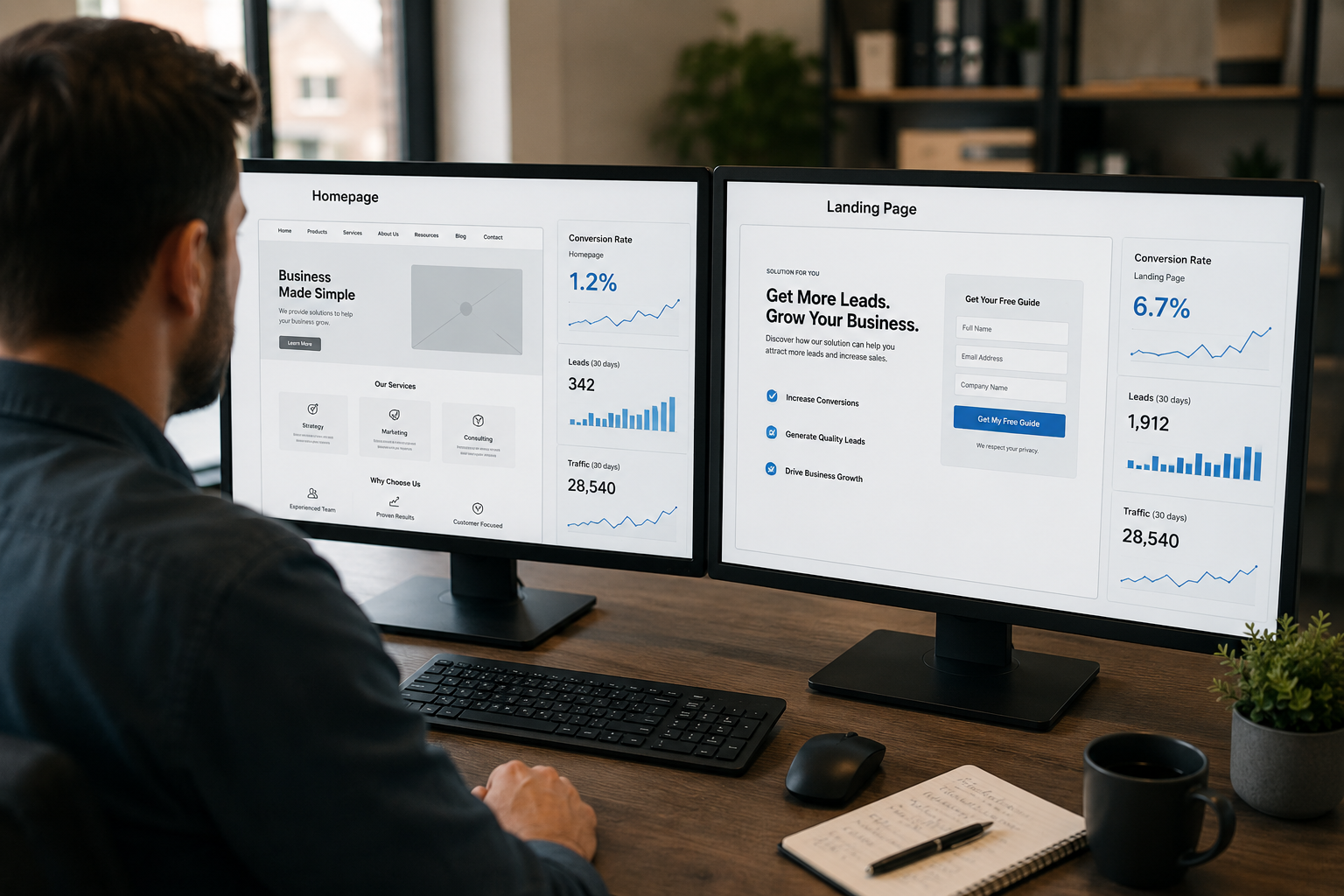
For small businesses trying to generate leads online, that difference can have a major impact. A homepage can build trust and guide visitors, but a landing page often converts better when traffic comes from ads, emails, social media campaigns, or specific service searches.

The stronger strategy is knowing when to use each one.

What Is the Difference Between a Homepage and a Landing Page?

A homepage gives visitors a broad overview of your business. It usually includes navigation, multiple service links, company information, calls to action, testimonials, location details, and paths to several different parts of the website.

That makes sense because homepage visitors often arrive with different levels of intent. Some are researching. Some are comparing companies. Some are returning customers looking for contact information. Others are trying to figure out whether your business offers what they need.

A landing page is narrower by design. It is built around one clear goal, such as booking a consultation, requesting a quote, downloading a guide, signing up for a service, or calling the business. The content, layout, headline, form, and call to action all support that one conversion goal.

Google defines a landing page as the webpage people reach after clicking an ad, and its advertising guidance emphasizes that landing page experience is influenced by relevance, usefulness, and ease of navigation (Google Ads Help, Google Ads Help).

Landing Page vs Homepage Conversion: Which Usually Performs Better?

In most campaign situations, landing page vs homepage conversion comes down to focus. A landing page often drives more leads because it removes distractions and keeps the visitor moving toward one action.

Imagine a local business running Google Ads for “emergency plumbing repair.” If someone clicks that ad and lands on the homepage, they may see links for plumbing, HVAC, financing, company history, blog posts, careers, and general contact information. Some of that content may be useful, but it also creates more opportunities to drift away from the original goal.

If that same visitor lands on a dedicated emergency plumbing page with a clear headline, urgent service details, trust signals, service area information, and a prominent call button, the path is much cleaner.

That is why dedicated landing pages are so valuable for paid ads and targeted campaigns. Unbounce’s landing page benchmark report, based on tens of millions of conversions, shows that landing page conversion performance varies widely by industry, which is another reminder that page design, audience intent, and offer quality all matter (Unbounce).

A homepage can still convert well, especially for branded searches and returning visitors. But when the traffic source has a specific intent, a focused landing page usually gives that visitor a better path to action.

Why Homepages Still Matter for Lead Generation

It would be a mistake to treat the homepage as less important. For many small businesses, the homepage is one of the most visited pages on the website. It is also where many people go after seeing a social media post, reading a review, hearing about the business from a friend, or searching the company name directly.

A strong homepage helps visitors understand the business quickly. It should communicate who you serve, what problems you solve, why customers trust you, and what someone should do next.

For local businesses in Lynchburg and across Central Virginia, the homepage also supports credibility. Customers may want to see service areas, local experience, reviews, photos, team information, and clear contact options before reaching out.

A homepage should not try to do the job of every landing page, but it should make the next step obvious. If visitors have to hunt for your phone number, scroll past vague messaging, or click through several pages before understanding your services, lead generation will suffer.

When a Landing Page Is the Better Choice

A landing page is usually the better option when the visitor arrives from a specific campaign. This includes Google Ads, Facebook Ads, email campaigns, social media promotions, QR codes, event campaigns, and service-specific offers.

Landing pages work especially well when the business wants to match the page closely to the visitor’s intent. A campaign promoting “commercial HVAC maintenance” should not send people to a generic homepage if a dedicated page can speak directly to facility managers, maintenance concerns, service agreements, and scheduling.

The same applies to digital marketing campaigns. A business promoting reputation management, website development, or social media services can often generate better leads by sending visitors to a focused page that explains that exact service and includes a clear call to action.

This is where conversion strategy and website development meet. The page needs to look professional, load quickly, answer the right questions, and make action feel simple.

What Makes a Landing Page Convert?

A high-converting landing page starts with message match. The headline should clearly connect to the ad, email, or post that brought the visitor there. If the campaign promises a free estimate, the landing page should make that estimate easy to request. If the campaign promotes a specific service, the page should not force the visitor to sort through unrelated information.

The page should also include trust signals. Reviews, certifications, project photos, client logos, case studies, local service areas, and clear contact details can all help reduce hesitation.

Forms matter too. A quote request form should ask for enough information to qualify the lead without becoming a tiny interrogation chamber. Every extra field should have a reason for being there.

Calls to action should be visible and specific. “Request a Quote,” “Schedule a Consultation,” or “Call Today” usually gives visitors a clearer next step than vague language like “Learn More.”

Strong landing pages are also easy to test. Businesses can experiment with headlines, page length, form fields, button text, photos, and offers to see what improves results over time.

How Homepages and Landing Pages Should Work Together

The best websites use homepages and landing pages as part of the same marketing system. The homepage builds broad credibility and gives visitors a complete view of the business. Landing pages support specific campaigns and conversion goals.

For example, a local service business may use its homepage to introduce the company, highlight core services, show reviews, and connect visitors to major service pages. At the same time, it may use dedicated landing pages for seasonal promotions, paid ad campaigns, location-specific services, or lead magnets.

This approach is especially useful for small businesses competing with larger brands. A strong website gives the business credibility, while focused campaign pages help turn traffic into measurable leads.

At TinyBull Marketing, website strategy often connects with SEO, digital advertising, content marketing, and social media. That integrated approach matters because traffic alone does not grow a business. The website has to give visitors a clear reason to take action.

You can explore more digital marketing insights on the TinyBull blog, learn more about TinyBull’s approach as a growth partner on the About Us page, or review the agency’s social media marketing services if your campaigns need stronger content support.

Which Page Should Your Business Use?

If someone is searching your business name, browsing your company, or trying to understand everything you offer, the homepage should provide a strong first impression. If someone is clicking a specific ad, opening a campaign email, scanning a QR code, or responding to a focused offer, a landing page is usually the better choice.

For many businesses, the answer is both. A polished homepage builds trust across all traffic sources, while targeted landing pages help specific campaigns convert more effectively.

If your website is getting traffic but not enough leads, the problem may not be visibility. The problem may be the path visitors are taking once they arrive.

TinyBull helps businesses build smarter digital marketing systems, from website strategy and SEO to advertising, content, and conversion-focused campaigns. If your business needs a clearer path from clicks to customers, connect with TinyBull Marketing to start the conversation.

Frequently Asked Questions

What is the main difference between a landing page and a homepage?

A homepage introduces the overall business and helps visitors navigate to different areas of the website. A landing page is focused on one campaign, offer, service, or conversion goal.

Which converts better, a landing page or homepage?

A landing page often converts better for targeted campaigns because it is more focused and has fewer distractions. A homepage can still convert well for branded searches, referrals, and visitors who want a broader view of the business.

Should Google Ads go to a homepage or landing page?

Most Google Ads campaigns perform better when traffic goes to a relevant landing page that matches the ad’s message and intent. This creates a clearer user experience and can support better campaign performance.

Can small businesses use both homepages and landing pages?

Yes. Most small businesses should use both. The homepage supports credibility and navigation, while landing pages support specific campaigns, offers, and lead generation goals.