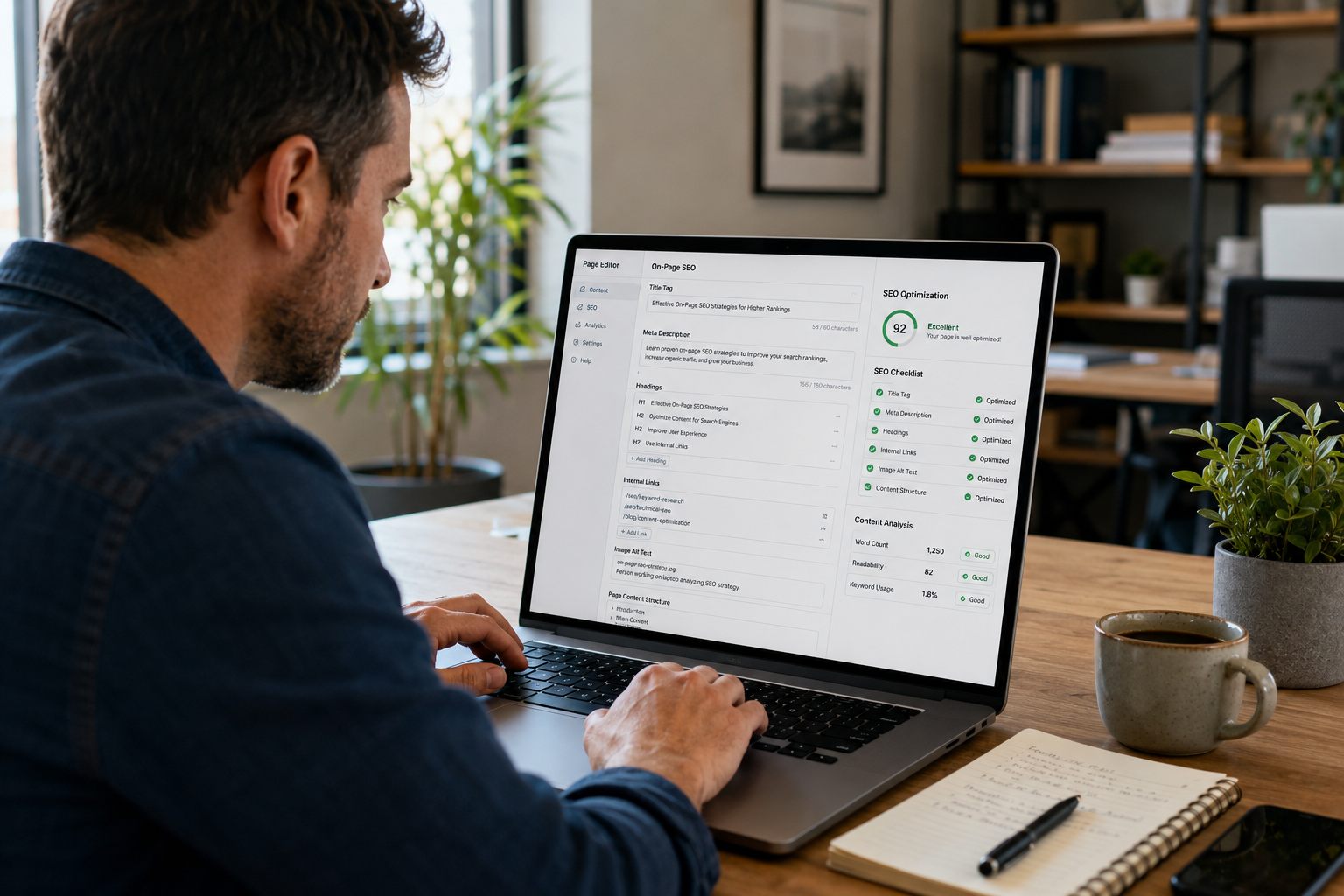
If you want your website to show up in search results, understanding on page SEO basics is a smart place to start. On-page SEO helps search engines understand what each page is about while making the page clearer and more useful for potential customers.
For small businesses, this matters because your website is often one of the first places people interact with your brand. A customer may find you through Google before they ever call, visit, or fill out a form. If your pages are confusing, thin, slow, or poorly organized, both search engines and visitors may struggle to understand why your business is the right choice.
Good on-page SEO does not mean stuffing keywords into every corner of a page. It means creating pages that are clear, helpful, well-structured, and aligned with what customers are actually searching for.
For small, local businesses, those details can make the difference between being found online and being buried below competitors.
What Is On-Page SEO?
On-page SEO is the process of optimizing the visible and technical elements on an individual webpage. This includes the title tag, meta description, headings, body content, images, internal links, URLs, and overall page structure.
The goal is to help search engines understand the page while giving visitors a better experience. Google’s SEO Starter Guide explains that useful content, descriptive titles, helpful links, and clear page structure all help search engines crawl, understand, and display website content more effectively (Google Search Central).
For a small business website, on-page SEO might involve improving a service page so it clearly explains what the company offers, where it works, who it helps, and what someone should do next. That may sound simple, but many business websites skip important details or make customers work too hard to find them.
On Page SEO Basics Start With Search Intent
Before editing titles, headings, or copy, it helps to understand search intent. Search intent is the reason behind a person’s search.
Someone searching “emergency plumber near me” has a different need than someone searching “how often should I service my water heater.” One person may be ready to call immediately. The other may be researching maintenance. Both searches could matter to a plumbing company, but they should lead to different kinds of pages.
This is where many small businesses get tangled. They try to make one page do too much. A homepage, service page, blog post, and landing page each serve different purposes. On-page SEO works best when each page has a clear job.
A service page should explain the service and encourage action. A blog post should answer a question or educate the reader. A homepage should introduce the business and guide people toward the right next step. When the purpose is clear, the page becomes easier to optimize.
Title Tags and Meta Descriptions Still Matter
The title tag is one of the most important on-page SEO elements. It is often used as the clickable headline in search results, and it helps Google understand the main topic of the page.
A good title tag should be specific, readable, and aligned with the search intent. For example, a page titled “HVAC Maintenance in Lynchburg, VA” is clearer than a vague title like “Services.” Clear titles help both search engines and customers know what to expect.
Meta descriptions do not directly guarantee rankings, but they can influence how people respond to your listing in search results. A well-written meta description summarizes the page and gives users a reason to click.
Google notes that it may use the meta description as the search snippet when it accurately summarizes the page, although snippets can also be generated from page content depending on the search (Google Search Central).
For small businesses, the best meta descriptions are usually clear and practical. They should explain what the page offers, include the main topic naturally, and speak to what the customer needs.
Headings Help Organize the Page
Headings make a page easier to scan. They also help search engines understand how the content is organized.
Every main page should have one clear H1 heading that matches the topic of the page. Supporting sections should use H2 headings, and deeper subsections can use H3 headings when needed. This structure gives the page a logical flow.
For readers, headings act like signposts. A busy business owner or customer may skim before deciding whether to keep reading. If the headings clearly explain what each section covers, visitors can find the information they need more quickly.
The goal is not to force keywords into every heading but instead to make the page easier to understand.
Helpful Content Is the Core of On-Page SEO
Search engines have become much better at recognizing pages that are genuinely useful. Thin, generic content rarely gives small businesses an advantage, especially in competitive local markets.
Strong website content should answer the questions customers are already asking. What does the service include? Who needs it? How does the process work? What should someone know before hiring a company? What areas do you serve? Why should a customer trust you?
For a local business, the most effective content often comes from real conversations with customers. Sales calls, service questions, reviews, objections, and appointment notes can all reveal what people need to know before they convert.
At TinyBull Marketing, content strategy is often connected with SEO, website development, social media, and reputation management because customers rarely make decisions from one single touchpoint. They compare, research, check reviews, browse the website, and look for signs that the business is credible.
Internal Links Guide Visitors and Search Engines
Internal links connect one page of your website to another. They help visitors find related information, and they help search engines discover and understand your content.
For example, a blog post about local SEO might link to a related service page or another article that explains Google Business Profile optimization. A service page might link to a case study, FAQ page, or contact form.
Internal links should feel natural. They should help the reader continue their journey instead of interrupting it.
For businesses creating ongoing content, internal linking becomes more valuable over time. Each new blog post, service page, or resource can support the larger website structure when links are planned thoughtfully.
You can explore more SEO-focused articles in TinyBull’s SEO resources or browse broader digital marketing insights on the TinyBull blog.
Images Need Optimization Too
Images can improve a page, but they can also slow it down or create missed SEO opportunities if they are not optimized.
Small businesses should use image filenames that describe the image, compress large files before uploading, and add alt text that explains what the image shows. Alt text helps with accessibility and can also give search engines more context about the page.
A contractor’s project photo, for example, should not be uploaded as “IMG_4827.jpg” if it can be named something descriptive like “basement-waterproofing-project-lynchburg-va.jpg.” That small detail helps keep the website cleaner and more understandable.
Image optimization is especially important for mobile users. Large, heavy images can slow down a page, and slow pages can cost businesses leads.
On-Page SEO Works Best With a Bigger Strategy
On-page SEO is important, but it is only one part of search engine optimization. A business also needs strong technical performance, local SEO, reviews, backlinks, useful content, and a website experience that helps people take action.
That is why small businesses often struggle when they treat SEO as a one-time checklist. Optimizing one page can help, but consistent improvement across the website creates stronger long-term results.
TinyBull helps businesses build that bigger picture. From SEO and content marketing to website development, social media strategy, and reputation management, the goal is to create a digital presence that supports visibility and growth.
If your business needs help improving how customers find and understand you online, learn more about TinyBull and how a strategic marketing partner can help turn SEO into a practical growth system.
Frequently Asked Questions
What are on page SEO basics?
On-page SEO basics include optimizing title tags, meta descriptions, headings, page content, internal links, URLs, images, and overall page structure so search engines and users can better understand the page.
Why is on-page SEO important for small businesses?
On-page SEO helps small businesses improve search visibility, communicate services more clearly, support local rankings, and create a better experience for potential customers visiting the website.
How often should on-page SEO be updated?
Important website pages should be reviewed regularly, especially when services, locations, customer questions, or search trends change. Blog posts and older pages may also need updates as information becomes outdated.
Can on-page SEO improve local search rankings?
Yes. Clear service pages, location-specific content, optimized titles, internal links, and helpful local information can support better visibility in local search results.